SPOT: SimulaMet POsition and Time Lab
Research objectives
The SimulaMet POsition and Time lab (SPOT) supports a wide range of research activities at SimulaMet centered around satellite communications, precision timekeeping, and navigational security. The lab will in particular address the following research areas:
- Monitor and benchmark IP-over-satellite networks across different vendors and orbits (LEO and GEO) to analyze long-term trends, reliability, and quality of service.
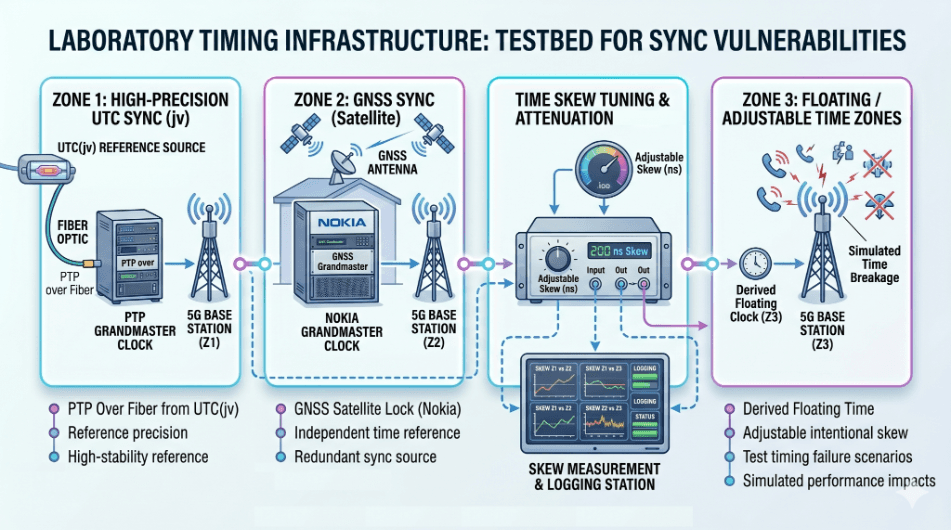
- Conduct high-precision time experiments utilizing extremely accurate time distribution over IEEE1588 from UTC(jv), cross-referenced with local atomic clocks and global satellite constellations.
- Study and mitigate GNSS jamming by developing new mechanisms for the detection of interference, protection of critical infrastructure, and the resilience and continuity of both positioning and timing systems under duress.
IP-over-Satellite Monitoring and Quality Analysis
The satellite communication landscape is rapidly evolving with the introduction of large-scale Low Earth Orbit (LEO) constellations, operating alongside traditional Geostationary Earth Orbit (GEO) systems. In the SPOT lab, we continuously monitor IP-over-satellite connections from major vendors, including Starlink, OneWeb, and Eutelsat. By capturing real-world data across these different network architectures, we are able to analyze performance trends, throughput, latency variations, and overall quality of service. This research helps us understand the capabilities and limitations of modern satellite broadband, enabling better integration of satellite links into terrestrial and critical communication infrastructures.
High-Precision Time Experiments
Accurate and reliable time synchronization is a fundamental pillar for modern telecommunications, data centers, and power grids. In this research activity, we explore the limits of precision timing and synchronization. Our laboratory setup receives extremely accurate time over IEEE1588 (Precision Time Protocol) distributed from the Norwegian Metrology Service, UTC(jv). To evaluate stability and precision, we continuously compare this network-delivered time against our own local cesium atomic clock, as well as GNSS-derived time signals from various global constellations. This multi-source experimental setup allows us to study clock drift, network-induced timing jitter, and the reliability of different time distribution protocols under varying network loads.
GNSS Jamming: Detection, Protection, and Resilience
Society’s reliance on Global Navigation Satellite Systems (GNSS) extends far beyond basic navigation; it is deeply embedded in the timing and synchronization of our critical infrastructure. Consequently, the disruption of GNSS signals through intentional jamming or spoofing represents a severe threat. Our research in the SPOT lab focuses on the full spectrum of GNSS interference: from early and accurate detection of jamming events, to the protection of receivers and downstream systems, and finally ensuring system resilience. We investigate how to maintain both accurate positioning and timing when primary GNSS signals are degraded or lost. By exploring sensor fusion, alternative timing sources, and robust network architectures, we aim to ensure uninterrupted operational continuity during adverse events.