Center for Resilient Networks and Applications
The Center for Resilient Networks and Applications (CRNA) conducts research on the robustness and reliability of communication networks underpinning applications of importance critical for the functioning of modern society. We focus on internet and mobile infrastructures including Internet of Things (IoT) and satellite, and research their various aspects including resilience, privacy and security.
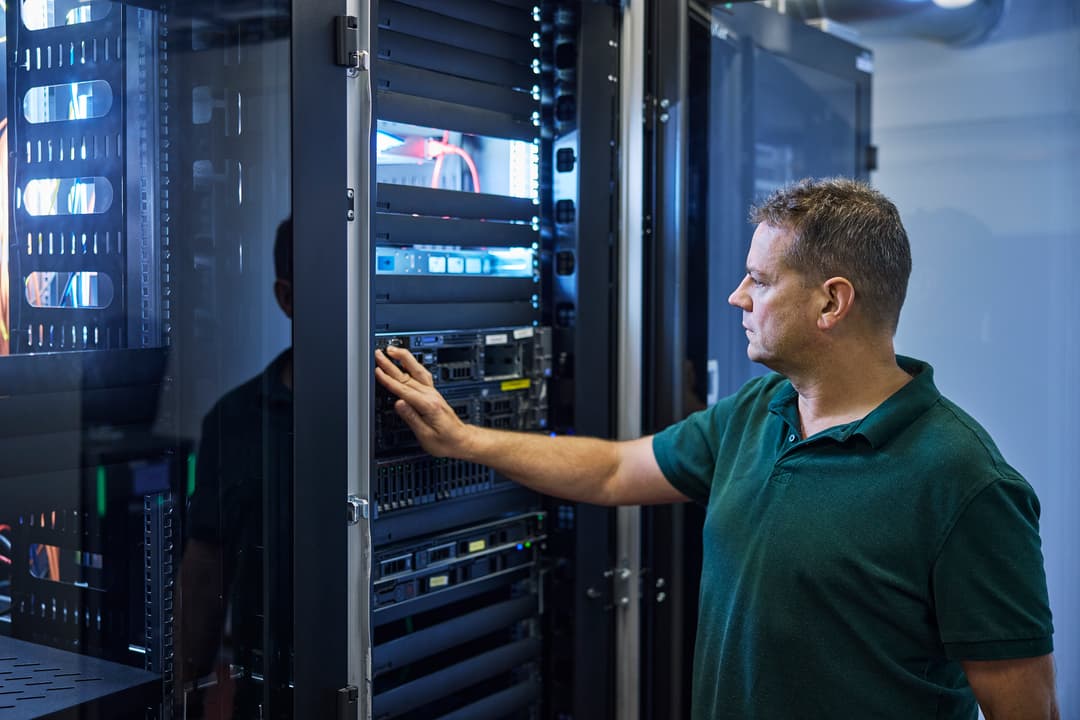
As society becomes increasingly dependent on internet applications, the consequences of failure become more severe. Technical failures, unplanned excessive load, design and implementation flaws in components, human error, and malicious intent all have the potential to interfere with services that rely on the internet.
CRNA was established to address these problems, conducting theoretical and empirical research on the robustness and security of ICT infrastructures. We seek ways to ensure that applications continue to function at their best possible level of quality and security, even in the face of unplanned events.
Focus areas
Improving the resilience and robustness of mobile networks
The rapid development of 5G/6G technology enables new applications, such as private cellular networks, integrated sensing and communication, and integration with satellite technologies. At the same time, new challenges arise around efficient network management, security, robustness, resilience and interoperability. Our vision is that the mobile networks, with integrated AI control and management systems, shall be able to underpin even the most critical applications, which are today run on special-purpose networks.
New AI models are transforming how data networks are managed and controlled. Operators and society need to fully understand the possibilities this technology enables, but also the challenges it creates.
Tarik Cicic, Head of CRNA
Digital vulnerabilities and network sovereignty
Network infrastructures are increasingly distributed as a consequence of network functions transitioning from hardware to software, virtualization and cloudification. While desirable from an operational perspective, this change comes at the cost of increasing society’s vulnerability to cyber-attacks and major disruptions.
Few countries can control their own digital vulnerability alone - the vast majority inherit vulnerabilities from other countries.
Professor Olav Lysne
Network security and privacy
We research various aspects of cyber security and privacy in the evolving threat landscape of next generation communication. An important component of our work is to uncover the technical consequences of using 'apps', in terms of what happens to our data as well as the geographical dependencies of the digital ecosystem that these apps rely on. This work will also be extended to the Internet of Things (IoT).
In addition to investigating what happens to data shared online, we contribute to Norway’s cyber security strategy by assisting in building the next generation of resilient and secure critical communications infrastructure using research-based innovations.
Privacy preservation is the next frontier. As more data is being collected and shared it is increasingly important to ensure that individuals' personal information is protected and not misused.Haakon Bryhni, deputy head of CRNA
Haakon Bryhni, deputy head of CRNA
Main activities
Long-term monitoring of Norwegian mobile broadband networks. The Center receives funding from the Norwegian Ministry of Digitalization and Public Governance to conduct long-term measurements of availability and performance of Norwegian mobile broadband networks. The measurements form the basis for an annual report on the stability and performance of these networks.
SimulaMet Interoperability Lab (SMIL). We own and operate a network laboratory extending over two data centers, a hands-on research area and roof-mounted 5G and satellite network installations, with full control of all components from servers and physical connections to radio networks and satellite terminals. We prioritize open source software wherever possible. In the SMIL lab we are developing the technical groundwork for the future emergency, IoT, satellite and 6G network communications.
Satellite communications and timing resilience. As connectivity expands into space, we evaluate the performance and reliability of emerging non-terrestrial network infrastructures, including LEO constellations like Starlink and OneWeb, traditional GEO systems and emerging space-based cellular broadband. Critical infrastructure, including power grids and telecommunications, rely heavily on very accurate timekeeping often directed from the satellite GNSS services. In the SimulaMet POsition and Time project (SPOT), we conduct high-precision time experiments and research activities to detect, mitigate, and ensure operational resilience against GNSS jamming and spoofing, safeguarding both positioning and time synchronization during adverse events.
Key partners